
PODCAST EPISODE 368 – The Hidden Reason Smart People Get Stuck
PODCAST EPISODE 368 – The Hidden Reason Smart People Get Stuck
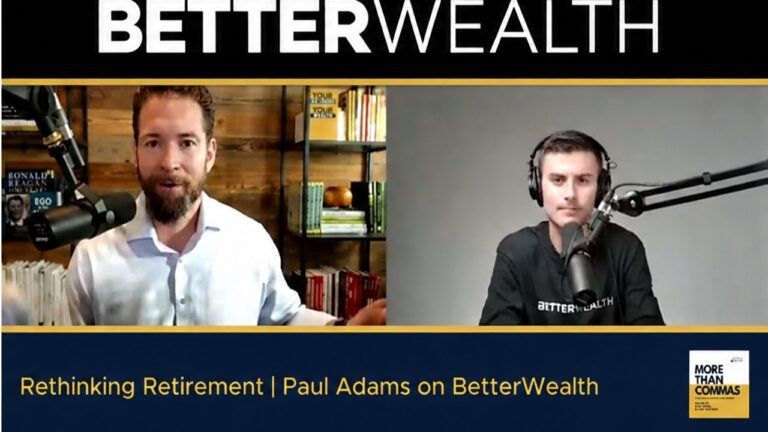
An episode of More Than Commas featuring John Patterson, co-founder and CEO of Influential U, on the hidden intelligence behind every transaction, and why the expertise that made you successful might be exactly what’s holding you back.








Most high earners get where they are because of their expertise. But what happens in the actual moment-to-moment exchanges with people, the conversations, negotiations, and everyday interactions, that may be quietly holding us back?
That’s the question I wanted to dig into with John Patterson, co-founder and CEO of Influential U, a business education company he’s run for the past 17 years, for this episode of More Than Commas.
John kicked things off by explaining the idea at the center of everything that follows: Transactional Intelligence, or TQ, a methodology for seeing the hidden layer beneath every human exchange. I’ve been part of Influential U’s programs since 2016, so this conversation picks up right where my own experience with it began.
Key Takeaways:
- Expertise alone can quietly stall your growth. The very thing that made you successful can keep you from seeing what’s actually happening in a transaction.
- Being “transactional” isn’t the problem. Everyone transacts constantly; the real issue is low TQ, transacting poorly rather than well.
- Every transaction moves through eight exchanges in a continuous cycle: invitation, presentation, contract, activity, fulfillment, completion, measure, and back around again.
- Your greatest strength can become a weakness when it’s applied indiscriminately, instead of recognizing where other people’s strengths fit better.
- The life you actually want is usually on the other side of the friction you’ve been avoiding, not on the other side of working harder.

Why Smart, Successful People Still Get Stuck
Before digging into the topic, I want to make one thing clear about the program itself: when someone asks what kind of return they can expect from a six-month course like this, the honest answer is that no one can promise a specific financial outcome. Nothing I can offer will outweigh the value of genuinely understanding your own income and how it’s produced.
So I asked John what the common thread is in people who feel stuck, even after years of building specialized expertise and reaching well into six figures.
More often than not, he told me, people rely on their expertise to point them toward the right solution. He gave me an example, a good friend of his, who happens to be named Doctor Frankenstein (a real person, not the fictional one), who served for a time as president of the California Medical Association and trained at a well-regarded medical school. Brilliant, highly accomplished, and like a lot of professionals with deep specialized training, prone to what John calls a kind of “doctor god complex,” the assumption that intelligence in one domain automatically transfers to every other part of life.
As his friend puts it: “I’m smart, I don’t need to know all that stuff, I’ll work through it with the smarts I have.” That mindset, John told me, is exactly how expertise can quietly work against you. The exchange you’re in right now is the exchange that’s going to affect your bottom line. Net worth is really just a trailing indicator of a handful of transactions navigated well, or not. If you can’t see a transaction for what it actually is, the outcome is mostly left to chance.
That landed for me personally. Before working with Influential U, I always believed my own expertise was the reason people chose to work with me, and I deliberately avoided anything that felt like sales. Being persuasive in financial planning felt, to me, uncomfortably close to being a salesperson. For years, I simply leaned on my expertise instead. What I didn’t realize is that getting better at the transaction itself, paying attention to who someone is as a person within that exchange, is actually a way of caring for people more fully, not less.
You’ve Been Transacting Your Whole Life
That instinct, to see every interaction as a kind of sterile “transaction,” misses the point entirely. John pushed back on it immediately: we’ve all been transacting our whole lives, with family, customers, colleagues, constantly. What people usually mean when they say an interaction “felt transactional” isn’t that a transaction happened, it’s that it happened poorly. That’s low TQ. The transaction still took place; it just wasn’t handled well.
High TQ is the alternative: navigating an exchange in a way that brings both people along together, something more reciprocal, more honoring of both parties’ goals. John described it well: riding in the front seat of an old car, his dad pulling out a map so they could both see where they were and where they were headed. Transactional Intelligence works the same way, pulling out the map and making sure both sides are oriented before moving forward.
This is the foundation of John’s book, High TQ: Why It Matters More Than Expertise, built around the idea of a hidden intelligence behind every human exchange.
Something John said stuck with me. He told me he’d been asked recently what his best attribute is, and his answer was the same as his worst one: his willingness to tell the truth. That’s a reminder I need to hear regularly too, that my balance sheet, my career, my relationships, my family, it’s all a culmination of how I’ve transacted with people up until this very moment. Most of us transact by default rather than by design, since nothing in traditional schooling goes much further than “be polite, say please and thank you.”
One of the things I love most about John’s book is how many real, personal examples it includes of people recognizing their own “zone,” sometimes called a Genius Zone or unique ability. I’ve experienced this firsthand. I used to have to carefully schedule recovery time after demanding stretches of work, almost like an athlete managing rest. Now, with the right people handling the parts of the business that used to drain my energy, my mornings start at 4:30 and nothing gets scheduled early enough that I have to think about my day in advance. By the time my workday ends, I’m 100% present with my family, not distracted by email or lingering tasks.
Understanding how I was transacting, and how my organization was transacting with people, what everyone’s naturally good at and drawn to, opened the door not just to a better life for me, but to designing better roles for my whole team, by putting each person in the part of the transaction where they genuinely thrive.
What Is a Transaction, Really?
It’s worth pausing here to explain something a lot of listeners probably want to know: what actually is a transaction, and can John show it to me rather than just describe it?
Here’s how he put it. Imagine a clock face running clockwise, and around it are eight equally spaced exchanges. It’s a continuous cycle, so it never starts and never stops, it’s always running. We step into these exchanges all day long: invitation, presentation, contract, activity, fulfillment, completion, measure, and so on, like stops on a subway line.
Most of us try to rush through these stops rather than staying present in the exchange we’re actually in, and when that happens, something John calls looping tends to occur. He described it well: each of us loves our favorite part of that transaction cycle. For John, that’s the part that starts with assessment around 11 o’clock, moving into invention at noon, his favorite place, and one I share too, leaning into invitation right after.
Since that’s everyone’s favorite part, the other parts of the transaction tend to suffer when there isn’t a team trained to handle them.
When Your Strength Works Against You
Here’s the catch John pointed out: the low TQ expression of a strength is to apply it indiscriminately. If invention is your genius zone, the instinct becomes invent, invent, invent, invent, invent, until the people around you are overwhelmed and scrambling to put out the fires that creates. We’re all genius in a particular place in the transaction cycle, truly genius, but when that genius gets applied to parts of the transaction it doesn’t fit, it tends not to work nearly as well, even though it feels like it should, since it’s often the only approach we’ve ever relied on.
That shifts once we start recognizing the value of other people’s genius within the transaction, rather than assuming our own approach applies everywhere.
John described one personality type that illustrates this well: someone who naturally wants to find problems and make sure rules are being followed. What that person usually wants is simple, to bring a problem forward and be thanked for noticing it, not necessarily to have it fixed immediately, just to feel heard.
I shared a personal example involving my mother, who fits this personality type. For years, my instinct was to meet her concerns with a lot of energy, trying to fix or debate the issue, which only created more friction. A mentor once described this pattern as being like a barn cat bringing you a mouse: the cat isn’t trying to cause a problem, it’s either offering a reward or trying to help because it doesn’t think you’re a very good hunter. Once I stopped trying to fix or debate the point and simply recognized the value in the feedback itself, the dynamic changed completely. The agitation I used to feel wasn’t really coming from her, it came from me operating from how I saw the world, instead of how she saw it.
The Four Roles Behind Every Exchange
“The life you want is on the other side of a lot of declines.”
Over the years I’ve worked with him, John has noticed a clear progression in how I apply TQ. First I learned to see the transaction cycle itself, all eight exchanges. Then I recognized myself in the role John calls inventor, the part of the transaction centered on generating ideas. From there, I started to see the other roles I hadn’t been serving nearly as well. Here’s how John breaks it down:
- Inventor – generating ideas
- Performer – the parts of the transaction where everybody gets aligned
- Producer – where a lot of the actual work gets done
- Judge – where everything gets accounted for and evaluated
Recognizing this helped me see where I genuinely excel, invention, and where I’d rather bring in the right people instead. As John puts it, that’s rare for someone like me: “For an inventor personality, we kind of think we’re good at everything, don’t we?”
John also pointed me to a familiar example of what happens when friction gets engineered out of a transaction entirely: Uber. His book walks through how Uber took each of the eight exchanges involved in hailing a cab and removed the friction at every one, and in doing so, reshaped the entire industry. John still remembers the first time he got out of an Uber at the airport without any haggling, after years of negotiating with cabs in Chicago. That moment stuck with him.
Over the years, John has watched me do something similar in my own life: engineering the friction out of everything that worked against my aims for family time, time in my congregation, time to travel, and the kind of work I actually wanted to do. The results weren’t about working harder to produce more. They were about working in a way that actually let me enjoy my life.
Finding Your Home in the Transaction
I told John about a friend of mine, a relatively new business owner who was carrying a heavy amount of agitation about everything he had going on. What I found myself explaining to him was simple: knowing the transaction cycle means always having a clear idea of the next step, even when you can’t act on it yet. Without that, people carry around a tremendous amount of cognitive load, a pile of incomplete things floating around that never gets mentally put to bed. Just being able to identify where you’re at in a transaction, even without getting better at it yet, brings real relief.
John added one more important distinction: people sometimes assume the personalities who show up well in transactions are naturally charismatic, good talkers, quick on their feet. That’s not actually what’s happening. It’s not about having the gift of gab. It’s about knowing where you are in the transaction, knowing where you’re best within it, and making the most of that value exchange.
At its core, a transaction is just a value exchange. Whatever you’re offering someone, tools, tips, better outcomes, a product, a service, every exchange is an opportunity to produce more value and focus it more clearly. The goal isn’t to become like me, or like Corey, or like anyone else. It’s to find your own home within the transaction and concentrate your value there.
As John puts it, once you find your home in the transaction, you tend to move more strategically toward what you actually want. All of this points back to the same core idea:
“Ultimately it’s the hidden intelligence behind every human exchange. Once you see it, you cannot unsee it.”
Where to go from here
- Want to talk it through? Get in touch with us.
- Curious about the framework? Download the Who We Are and Why It Matters white paper.
- Want the numbers for your own life? Run your own retirement projection with our free tool.
- Want to learn more from John and his team? Visit influentialu.global or find John on LinkedIn.
Every yes, every no, every contract, every pitch, every one of those is an exchange where you can make the most of it.
Paul is a paying participant in Influential U’s program. Sound Financial Group receives no compensation no matter how many people enroll, and no income or outcome is guaranteed.