
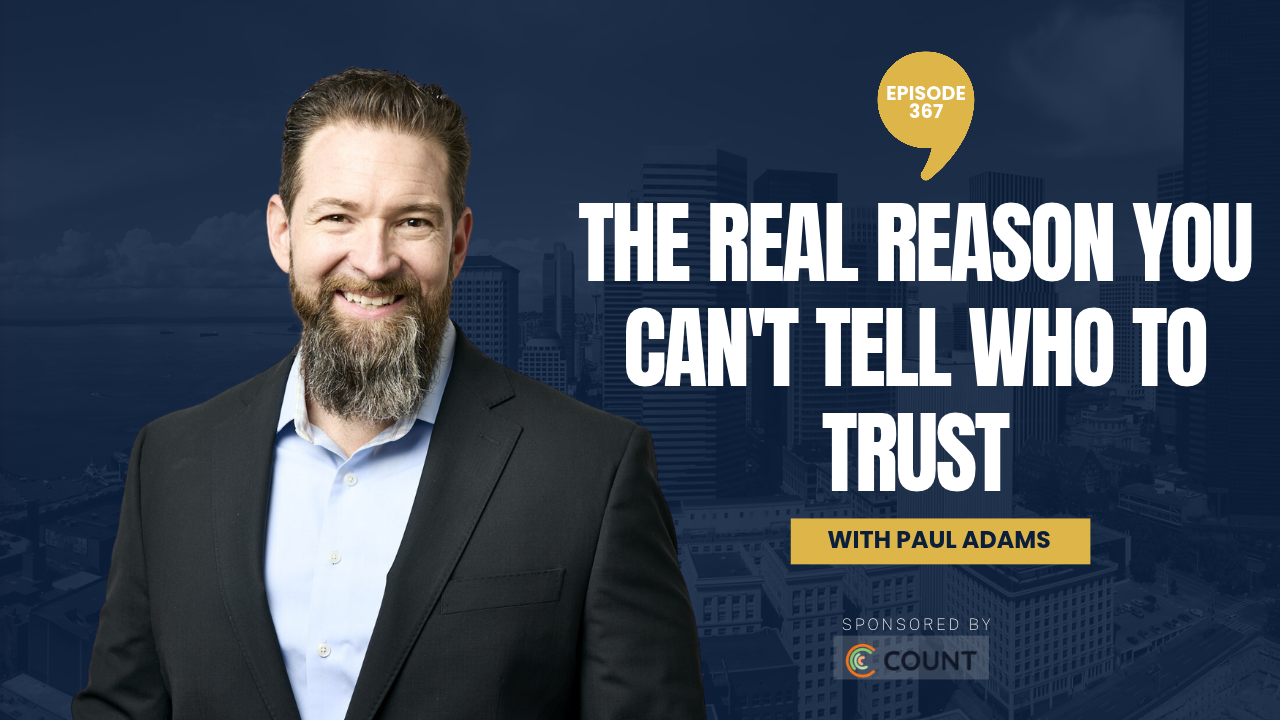
PODCAST EPISODE 367 – The Real Reason You Can’t Tell Who to Trust
PODCAST EPISODE 367 – The Real Reason You Can’t Tell Who to Trust
A short solo episode where Paul breaks down the four components of trust, and why trust doesn’t have to be a moral question.







I want to do something a little bit different with you today and talk about trust. We operate in the marketplace every day, whether you’re a business owner, a high earner not rich yet (a HENRY), or an executive.
This is for you, because it will give you a distinction for trust that is not just what everybody’s saying. Everybody’s like, “Well, you know what trust is.” But they cannot define what trust is. I hope that this short episode will give you some insight into that.
By the end of this post, you’ll know the four components of trust, why a shared future takes trust to the next level, and why trust isn’t always a moral question.
Key Takeaways:
- Trust has four components: sincerity, competence, reliability, and a shared future.
- Sincerity means someone’s public conversation with you matches their private one.
- A shared future is what separates real trust from a group of mercenaries who work well together.
- Trust isn’t always moral. You can trust someone to care for their own concerns, and that can still take care of yours.
What Are the Four Components of Trust?
So what are the components of trust?
We need to know that somebody is sincere, that they are competent, and that they are reliable. And for real trust, we need a fourth component, which is some type of shared future.
So let’s walk through each one of them.
What Is Sincerity?
Sincerity is that somebody is having some public conversation with you, and they don’t have a separate private conversation with themselves or with others that would betray the public conversation they have with you.
What Does Competence Mean?
Competence is, do they acquire the general and specialized knowledge necessary to actually be able to complete the task?
So if it’s me, and somebody’s asking, “Hey, can you build a rocket ship?” the answer is going to be sincere. I might really believe I could build a rocket ship, and I’m not telling you something different than I’m telling everybody else.
But then you get to competence, and wow. What’s Paul’s history? Has he ever built a rocket ship? Does he have any knowledge in this domain at all? If the answer is no, then right there you know you can’t trust.
What Makes Someone Reliable?
And then we have reliability. Reliability is, will this other person remember this promise long enough for them to fulfill it?
So somebody’s making you a promise they’re going to do something. They’re going to take you to the airport next Tuesday. Are they going to remember the promise to take you there all the way up until next Tuesday? Because if they don’t, then you have a problem with trust.
So again, it’s sincerity: do they have the same public conversation as private conversations? Competence: do they have the ability to do the job? Reliability: will you remember the promise to get the thing done long enough to get it done, for whatever relevant horizon of time the promise is over?
Why Does Trust Need a Shared Future?
And then lastly is a shared future. Now, that was not taught to me immediately.
I had learned a large chunk of that from the OG network originally, and it was built on the work of Fernando Flores. But Fernando Flores, when I had a chance to learn from him, taught it from the perspective that a shared future is required.
Because if all you have is sincerity, competence, and reliability, you can have a group of mercenaries that come together on a consulting project. They all work really well together, et cetera. But then when that thing is over, they all go their own way.
There’s something different about a trust that includes some shared future. You know that we’re going to work together, and there’s going to be good outcomes from this initial work for many years to come.
It could be a bigger shared future, like we are part of the same community, the same church, the same city. Maybe we’re doing something with someone, and a big part of the trust might be: we’re doing this thing, but we’re helping some bigger global thing.
But that idea of a shared future changes it from being almost mercenary in being effective in trust, to being able to take it to the next level.
Where to go from here
- Want to talk it through? Get in touch with us.
- Curious about the framework? Download the Who We Are and Why It Matters white paper.
- Want the numbers for your own life? Run your own retirement projection with our free tool.
Trust for the Sake of What?
Now, what does it matter that we’re trusting? I just talked about sincerity, competence, reliability. For the sake of what? How someone is going to interact with my concerns.
So somebody says that they are a massage therapist. Well, then you would want to know: are they sincere? Is that really what they do for a living, or are they trying to steal my wallet?
Competence: do they have board certifications, whatever local licensing is? And reliability: do they keep their schedule, et cetera? Do they have an environment when you walk in where you’re like, “Oh my gosh, this is conducive to me being relaxed and having a good time while I’m getting a massage”?
You assess this quietly in every transaction that you’re in, as it relates to the conditions of life that you care about.
Is Trust a Moral Question?
So you’ll also notice that trust, I didn’t put in a moral context. Because there are many people I trust that the way they’re going to interact with my concerns is predictable.
And it’s predictable that those people are going to consistently act against my concerns, or be indifferent to my concerns, while they fulfill their concerns.
So you can work with somebody really, really well for a very long period of time, based upon you knowing that all they’re going to do is care for their own concerns. They’re not going to care for your concerns.
But now, working with someone like that, if you know what they’re concerned about, and you know how they’re going to behave as it relates to taking care of their concerns, and that takes care of your concerns, well, that puts you in a really good situation.
You can work with and trust that person in that transaction, because you can trust them to take care of their concerns. And them taking care of their concerns happens to take care of yours.
“You can trust them to take care of their concerns. And them taking care of their concerns happens to take care of yours.”
That’s just a short little talk on trust. I’m trying this little bit of new format and a little bit different camera equipment. I hope you guys enjoyed that. I’m glad the More Than Commas family could be here for it. And I hope you guys get out there and get back to living a great life.