

PODCAST EPISODE 305 – How much does it take to Retire the 4% rule

In episode 305 of More than Commas, Host Elijah Fowler explores the crucial question of retirement funding through the lens of the 4% Rule. This popular guideline suggests retirees can withdraw 4% of their savings annually without depleting their funds over 30 years. Elijah discusses key factors influencing this rule, including market fluctuations, inflation, and personal expenses, emphasizing that while the 4% Rule is a useful starting point, it requires careful adjustment to fit individual circumstances.

—

This Material is Intended for General Public Use. By providing this material, we are not undertaking to provide investment advice for any specific individual or situation or to otherwise act in a fiduciary capacity. Please contact one of our financial professionals for guidance and information specific to your individual situation. Sound Financial LLC dba Sound Financial Group is a registered investment adviser.  Information presented is for educational purposes only and does not intend to make an offer or solicitation for the sale or purchase of any specific securities, investments, or investment strategies.  Investments involve risk and, unless otherwise stated, are not guaranteed.  Be sure to first consult with a qualified financial adviser and/or tax professional before implementing any strategy discussed herein. Past performance is not indicative of future performance. Insurance products and services are offered and sold through Sound Financial LLC dba Sound Financial Group and individually licensed and appointed agents in all appropriate jurisdictions. This podcast is meant for general informational purposes and is not to be construed as tax, legal, or investment advice. You should consult a financial professional regarding your individual situation. Guest speakers are not affiliated with Sound Financial LLC dba Sound Financial Group unless otherwise stated, and their opinions are their own. Opinions, estimates, forecasts, and statements of financial market trends are based on current market conditions and are subject to change without notice. Past performance is not a guarantee of future results.


Related Posts

  • PODCAST EPISODE 189: Brock Blake CEO of Lendio – Saving The American Dream

    EPISODE SUMMARY While March for many people was a month that spelled disaster, Brock Blake saw an opportunity, not to simply chase the American dream of financial gains through business, rather save it. In this episode, Paul and Cory speak with CEO of Lendio Brock Blake, on how March was the moment his company catapulted into its position and purpose….

  • Podcast Episode 32: Watch What You Say, It Could Cost You Millions

    LISTEN HERE EPISODE SUMMARY Paul Adams discusses financial philosophy on this episode. What would it mean to you to keep all your financial promises? So many people make promises to the people they love. They promise they’ll get a bigger house. They promise they’ll send their children to college. But few of them actually do the math to find out…

  • PODCAST EPISODE 220: Financial Independence at age 52, earning less than $100k

    WHAT WAS COVERED [Tweet “Pay yourself first, By saving for your future. #YourBusinessYourWealth”] [Tweet “What habits do you have that you can reconsider? What in your finances causes ‘death by a thousand cuts’? #YourBusinessYourWealth“] [Tweet “Setting an example in your financial lifestyle shows others that there is another path they can take if/when they find they are moving in the wrong direction…

  • Podcast Episode 24: The Differences Between Loss Tolerance and Risk Tolerance

    LISTEN HERE EPISODE SUMMARY Paul Adams explains the key differences between a loss tolerance mindset vs. a risk tolerance mindset. He shares a couple of examples throughout history of how thinking of your investment portfolio from a risk tolerance perspective can be deadly to your financial future when the market turns south. Instead, he says, frame your thoughts from a…

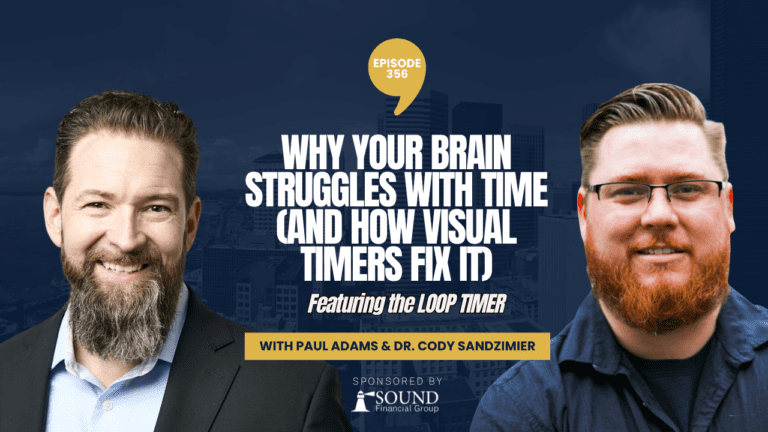
  • PODCAST EPISODE 356 – Why Your Brain Struggles With Time (And How Visual Timers Fix It)

    What if the reason you struggle with time management isn’t a lack of discipline, but biology? In this episode, Paul sits down with Dr. Cody Sandzimier, founder and owner of Redmond Spine Center and creator of the Loop Timer, to explore the surprising science behind how humans perceive time. The conversation dives into neuroscience, psychology, productivity, and practical strategies you…